

An Account Plan Is Not an Account Strategy
Introducing WinMinder, AI-native strategic-account coaching. You bring the account. WinMinder brings the standard.
Most account plans are not written to change an account.
They are written to survive a review.
I understand why. Leaders need visibility. Sellers need to show their work. A template gives everyone something to inspect.
But over time, account planning often becomes administrative work optimized for inspection. The plan gets longer. The fields get filled. The QBR deck looks complete.
And the account does not move.
AI-generated volume can make that problem worse. Any seller can now produce a ten-page plan in minutes. Stakeholder lists. Tables. Dozens of action items. It looks like work. It reads like strategy.
Volume is not judgment.
I use AI every day. I am not worried about AI. I am worried about AI with no standard behind it.
The strongest strategic sellers I have worked with do not need more documents. They need help thinking. Synthesizing what they know. Exposing the assumptions they have stopped questioning. Deciding which few moves actually matter this quarter.
That is the problem WinMinder is built to address.
What WinMinder Is
WinMinder is strategic-account coaching for enterprise sellers.
It is for enterprise AEs and strategic account directors who own a small number of complex, high-value accounts. It is for developing sellers who want to learn how a strong strategic seller thinks. And it is for sales leaders who want account reviews that report material progress instead of activity.
You bring the account. WinMinder brings the standard.
You know the customer, the people, the history, and the opportunity. WinMinder brings my strategic-account methodology, and the judgment behind it, through an AI coach that pressure-tests your thinking and helps you choose the few actions that can materially advance the account.
The output is not a longer plan. It is one living strategy, on one page, that you own.
Built AI-First
WinMinder was not built as a planning form with a chatbot bolted on.
It was conceived AI-first. The conversation is the interface.
There is no giant template to fill in. You start with an account name and tell the story in your own words. The coach follows the threads that matter and asks one useful question at a time.
That design reflects a simple view of what AI is genuinely good at.
It is good at synthesis. Turning a messy account story into a clear picture.
It is good at probing. Finding the weak assumption and asking about it.
It is good at pattern-matching against a standard. Recognizing when a situation looks like one that has gone wrong before.
It is good at drafting. Turning a conversation into a clear thesis, a short set of commitments, and an honest list of unknowns.
What it should not do is own the judgment. That stays with the seller.
Here is the part most people miss. Access to a model is not the hard part. Everyone has that now. Ask a general-purpose model for an account plan and you tend to get the average of everything it has read.
The average is not a standard.
The hard part is encoding real expertise so the AI reasons against a standard instead of averaging the internet. And then governing that standard so it gets more faithful over time instead of drifting.
That is where the work in WinMinder goes.
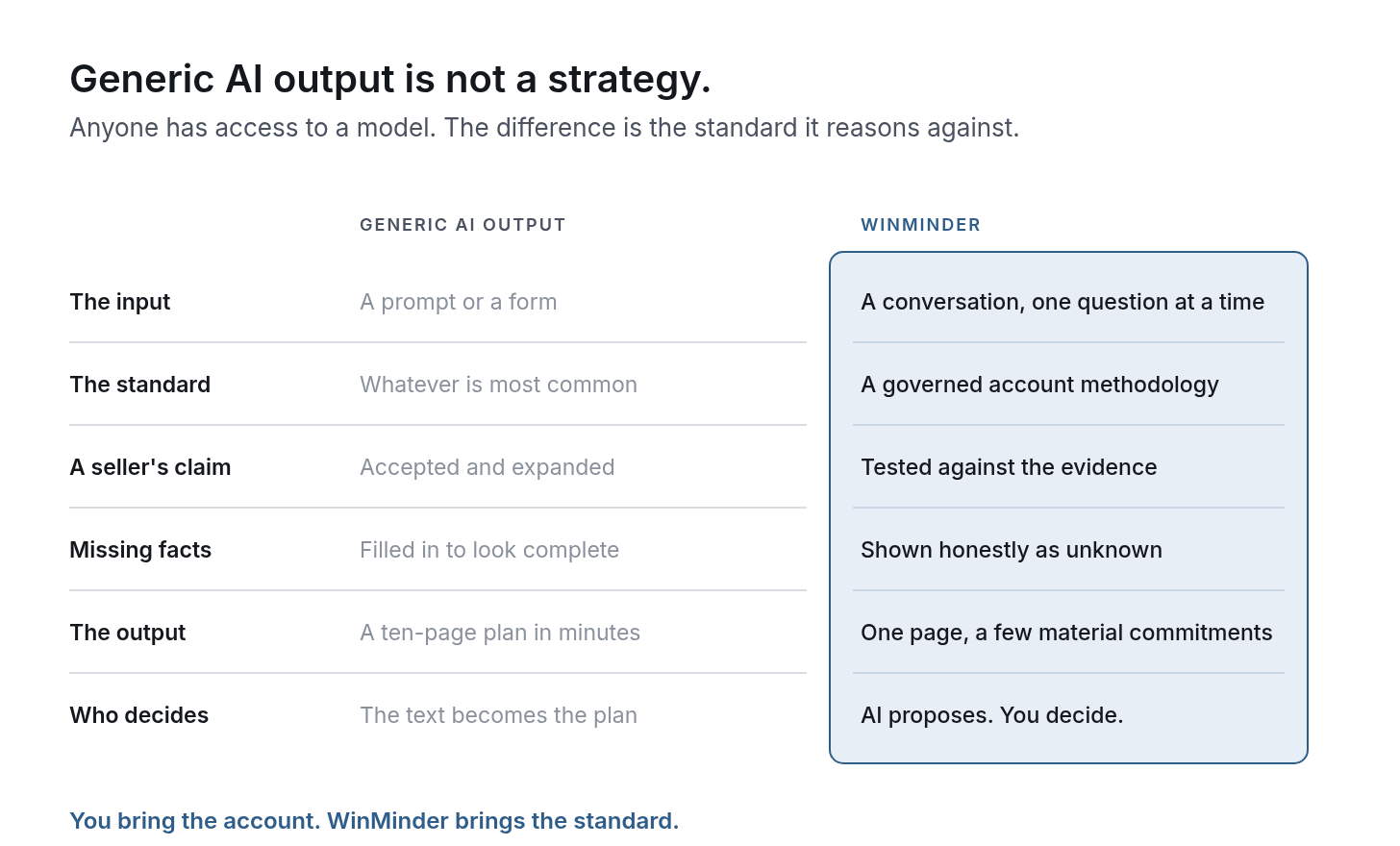
Anyone has access to a model. The difference is the standard it reasons against.
What WinMinder Is Not
Boundaries matter as much as features.
WinMinder is not a CRM. It does not forecast, manage pipeline, or rebuild your close plan. An account-level Big Deal Strategy belongs in WinMinder. An opportunity close plan does not.
It is not a contact database or an org chart. Curate; do not inventory.
It is not an activity tracker. Daily engagement is not the objective.
It is not project management. There are no task boards to maintain.
It is not generic AI advice. It will not invent a rule and present it as the methodology. When a situation falls outside what the methodology covers, it says so, and labels a general suggestion as general.
It is not a scoring engine. No invented aggregate scores. No confidence percentages. No gamified progress.
And it is not a claim to clone a person. The goal is increasingly faithful coaching, not a claim that AI will always respond exactly as I would.
WinMinder complements the tools you already use. It does one job: strategic account development.
Getting Challenged
The coaching starts with what you say. Then it tests it.
Consider a common statement:
“We have executive alignment because the CIO attended one meeting.”
It is easy to accept that and move on. WinMinder asks what that interaction actually demonstrates. Is the relationship tied to a priority the CIO owns? Did anything happen after the meeting?
An introduction is not executive alignment. A single meeting is not a relationship. The desired outcome is not another meeting. It is a more consequential relationship.
Or take a common Big Deal ambition:
“Get them to sign a $2M enterprise agreement next year.”
That is a desired outcome, not a strategy. A revenue target is not a strategy.
The better question is:
What could this account ultimately become, why would the customer rationally make that commitment, and what conditions must become true for us to earn it?
Or a stakeholder gap the seller has not noticed:
“Your IT Partnership strategy depends on enterprise standardization, but I do not see the CIO or an infrastructure or security leader represented. Is that intentional?”
The objective is not to fill a map. It is to expose strategic relationship risk.
Challenge is not the goal by itself. The coach recognizes strong evidence and does not manufacture objections. It also adapts. Experienced sellers move fast. Developing sellers get more teaching.
The Seller Owns the Plan
The AI proposes. The seller decides.
Strategy statements, commitments, stakeholder classifications, and maturity assessments start as proposals. You accept them, edit them, or reject them. Nothing becomes part of your plan until you accept it.
This is the right division of labor. The AI does the synthesis and the challenge. You own the judgment and the commitment.
You can also ask why. Why did the coach reach a conclusion? What supports it? The reasoning is there when you want it and out of the way when you do not.
The Methodology Layer
A framework alone is insufficient.
Most sellers have seen a framework. Few have had someone apply one to their account, with judgment, quarter after quarter. The value comes from interpreting ambiguous evidence, recognizing patterns, knowing when to challenge or teach, and proposing practical moves.
The WinMinder methodology is organized around five pillars:
Executive Alignment. Relevant, sustained relationships with the senior leaders whose priorities can materially influence the account.
IT Partnership. A durable, strategic place in the customer’s technology environment. More than technical approval.
Big Deal Strategy. The larger account destination, why the customer would rationally commit, and the conditions needed to earn it.
Key Use Case Development. Value-backed, deliberately sequenced expansion. Not generic whitespace mapping.
Account Team Collaboration. Mobilizing the right internal people and resources around the strategy, with you still owning it.
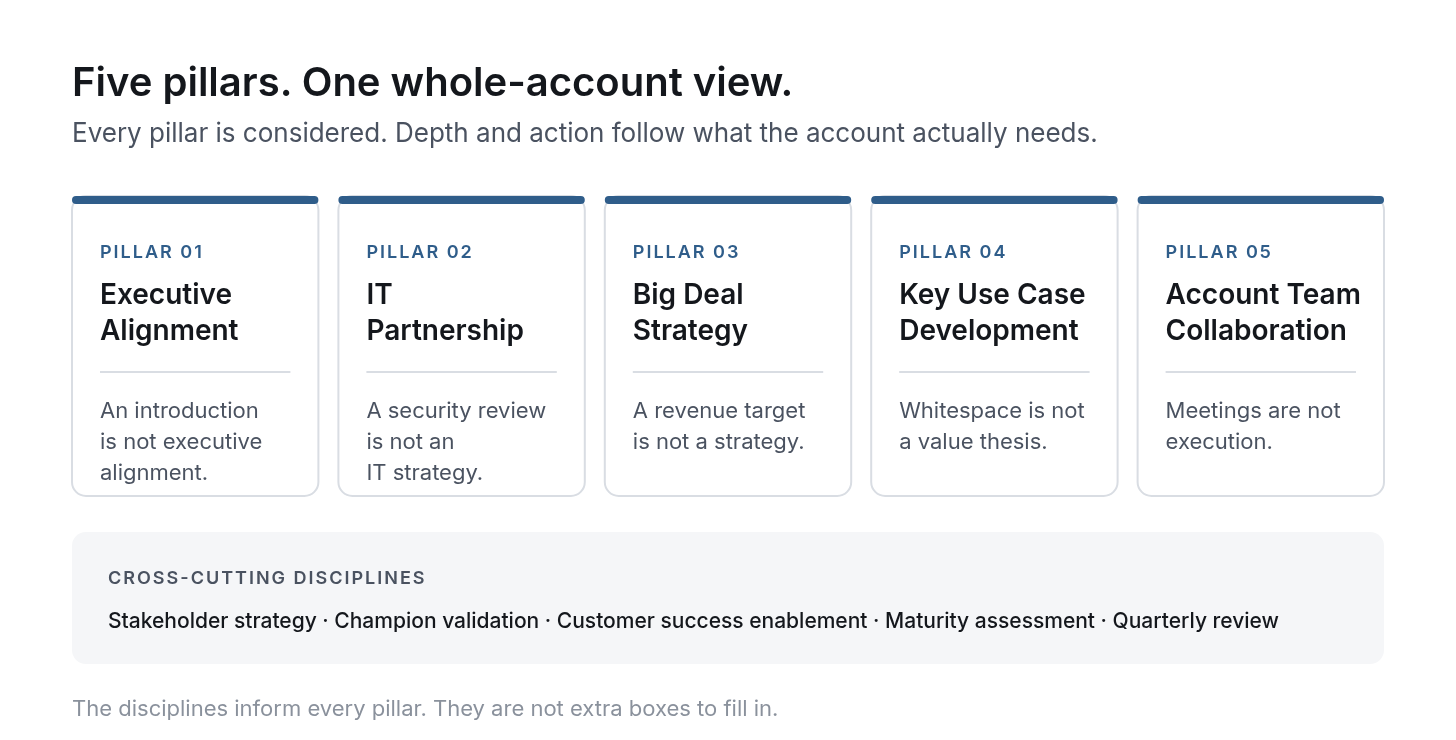
Five pillars, one whole-account view. The disciplines run through all of them.
Running through every pillar are cross-cutting disciplines: stakeholder strategy, champion validation, customer success enablement, maturity assessment, and quarterly review. They inform the pillars. They are not extra boxes to fill in.
It Can Disagree With You
A coach that always agrees is not a coach.
Maturity is a good example. Every pillar moves through the same five stages: Defined, Activated, Engaged, Evolving, Accelerating.
Defined does not mean executed.
You might rate your Executive Alignment as Evolving. WinMinder might assess it as Engaged, and say why. Customer interaction is active, but there is not yet sufficient evidence that the customer is co-shaping the strategy or that new relationships or opportunities are emerging from it.
Both judgments are shown. Neither overwrites the other. You decide the official assessment.
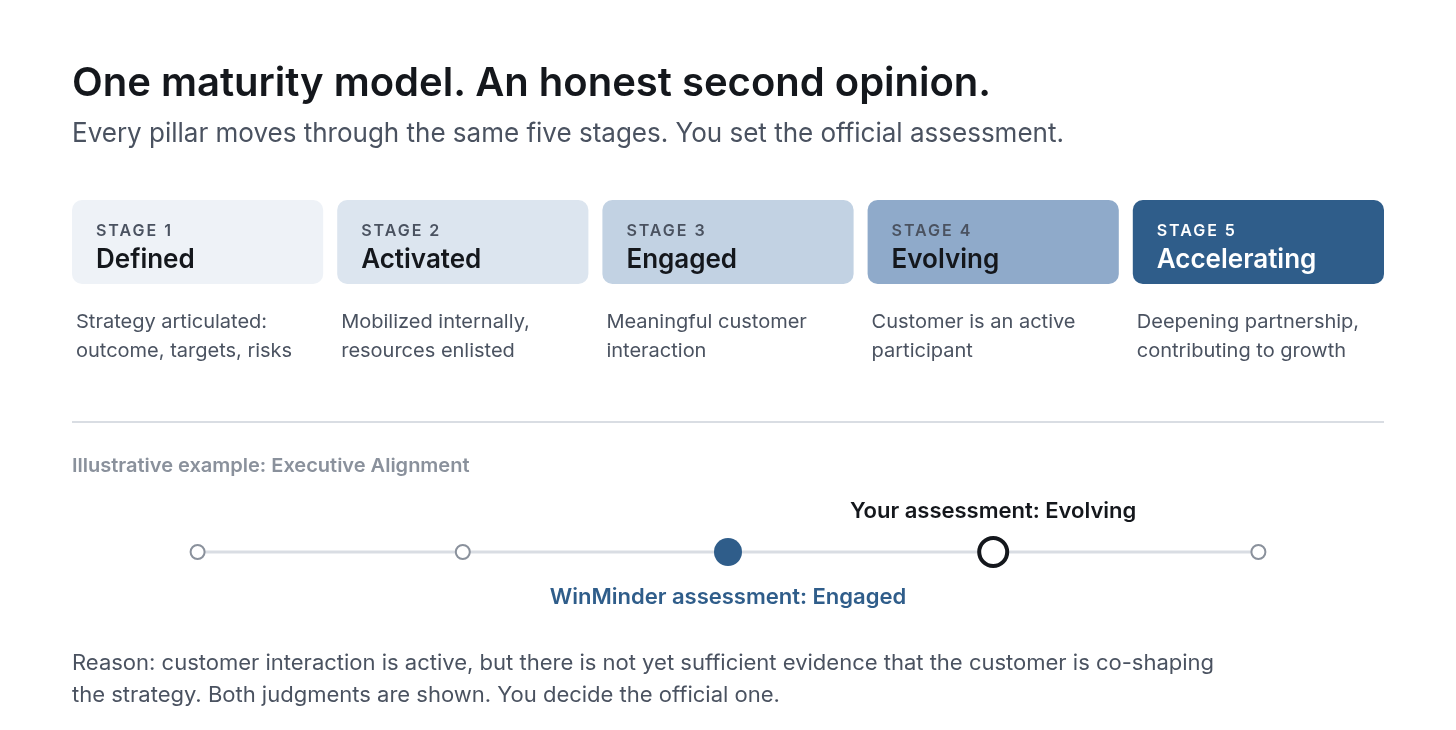
Illustrative example. Two judgments, side by side. The seller sets the official one.
A missing fact is treated as unknown, not as a negative finding. And disagreement is not the point. A useful conclusion is more important than agreement.
How the Methodology Learns
A fair question is whether WinMinder learns.
It does. But not the way most people assume.
It does not learn by training on your account conversations. Confidential account conversations are never automatically turned into reusable knowledge. Popularity is not validation. A coaching standard should not drift toward whatever is most common.
It learns from experience. Mine, deliberately.
I use AI as a thinking partner to get decades of enterprise selling out of my head and into a form the coach can use. Stories. Wins. Failure patterns. Exceptions. The question I asked at the moment it mattered, and what would have changed my judgment.
That is harder than it sounds. A good story compressed into a slogan loses the judgment that made it useful.
Nothing goes live because it was captured. I review it and approve it explicitly. Every addition is tested against realistic account scenarios before it goes live, including ones where it should not apply. Then it ships as a new version of the methodology.
I treat the methodology the way good teams treat software. Versioned. Reviewed. Tested before release.
The product itself is built the same way. I build WinMinder with AI coding agents working from written product and methodology documents. AI does a great deal of the work. A clear standard governs it.
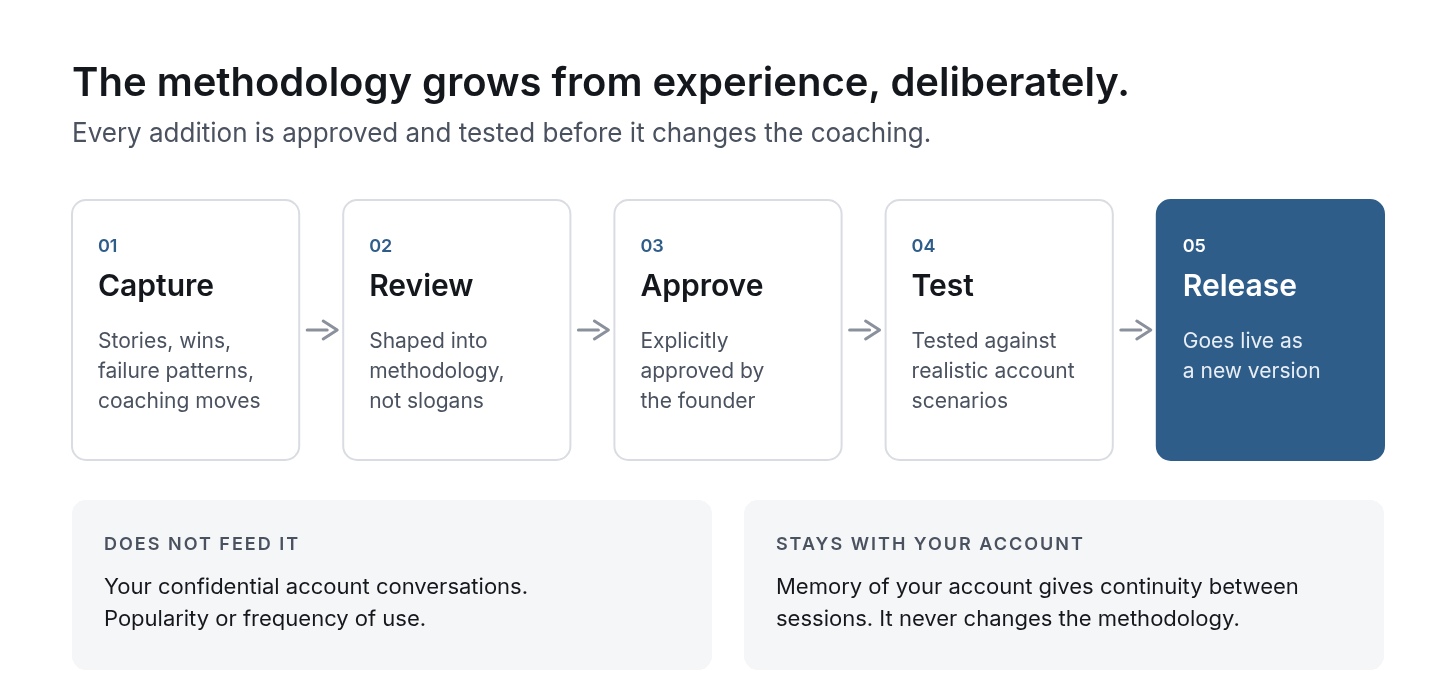
Every addition is approved and tested before it changes the coaching.
A successful situation does not establish a universal rule. A story is not automatically a rule.
That discipline is the point. It produces a governed standard that gets more faithful over time.
Your account is handled differently. WinMinder remembers your account, so you come back after a leadership change or at quarter end and pick up where you left off instead of retelling the story. That memory serves your account. It never changes the methodology.
This publication plays a role too. Ideas I write about here can become candidates for the methodology. But publishing an idea does not make it doctrine. It still has to be reviewed, approved, and tested like everything else.
What You Leave With
The goal is simple. A seller who knows an account should be able to spend roughly 30 to 45 minutes and leave with a useful first plan, even with incomplete information.
That plan fits on one page:
A strategic thesis. Your point of view on where the account can go and why.
Five pillar views. Each with a considered direction and unknowns shown honestly. “Not yet assessed” is an acceptable answer.
Curated key stakeholders. The people who materially affect the strategy.
Quarterly commitments. A small set, typically around five to eight across the account.
Risks and unknowns. What could derail the plan, stated plainly.
Then you come back when it matters. A material change. A leadership departure. A quarterly review.
At quarter end, the coach helps separate task completion from strategic impact. Incomplete work should not automatically roll forward. You decide what to carry forward, revise, replace, or drop. Then it helps you shape a narrative you own:
Here was our strategy. Here is what materially changed. Here is where we fell short. Here is what we learned. Here is what I recommend we do next.
Final Thought
The question is not whether you have an account plan. AI can give you one in minutes.
The better question is:
Does this help the seller think more clearly, produce a better strategy, or make a better strategic commitment?
That is the test I hold WinMinder to.
AI does the synthesis. The standard does the governing. The seller does the deciding.
Evidence before assertion. Strategy before activity.
You bring the account. WinMinder brings the standard.
Bring one account. Leave with a strategy you own. Learn more at winminder.ai, or request access at keith@winminder.ai.
Thanks for reading WinMinder. Subscribe for free to get new posts on the five pillars and the discipline of strategic account growth.